what brought the city of petra to an end
Petra: Ancient City of Rock
Located near 115 miles (185 km) southwest of Amman, Jordan, Petra was an ancient city that was literally carved into red desert cliffs. Its ornate ancient compages and natural beauty attract people from all over the world. Office of the motion-picture show "Indiana Jones and the Concluding Crusade" was filmed in Petra, bringing it more than pop attention.
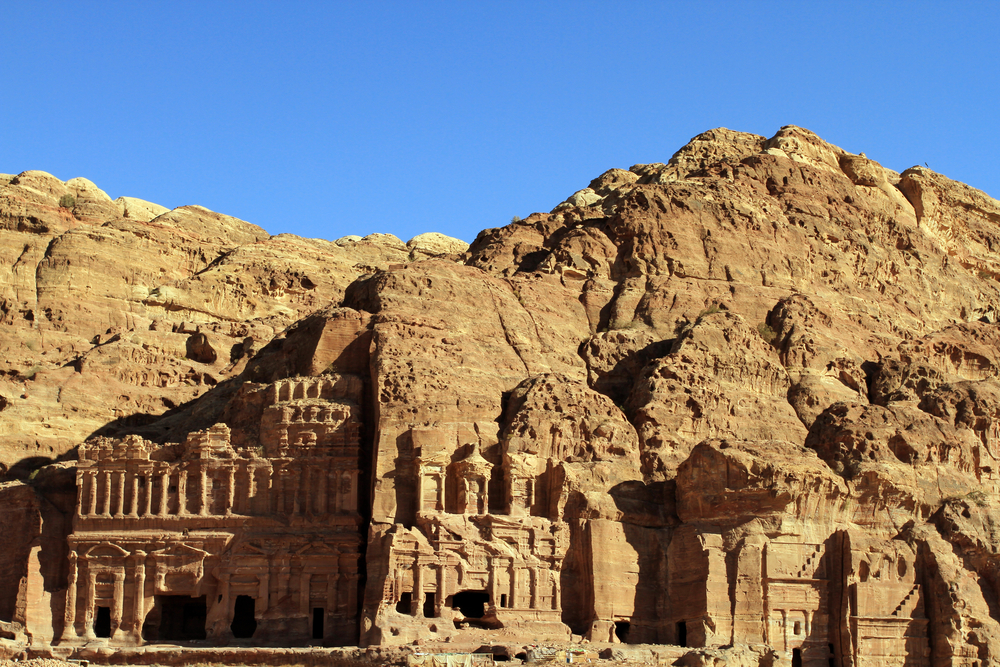
Until its annexation by Rome in 106 A.D., Petra served equally a majuscule for the Nabataeans, a people who wrote using an Aramaic linguistic communication and controlled caravan trade throughout the region.
The primeval mention of these people is from 312 B.C., when they plain withstood an attack by Antigonus, ane of Alexander the Bang-up's successors. In these early years the Nabataeans are believed to have lived a nomadic lifestyle, and Petra was likely a place of tents and simple structures.
This would change as the caravan trade developed, with Petra serving equally a center of trade between Arabia, Mesopotamia, Egypt and the eastern Mediterranean. The urban center reached its elevation about 2,000 years ago with a population estimated at 20,000 inhabitants.
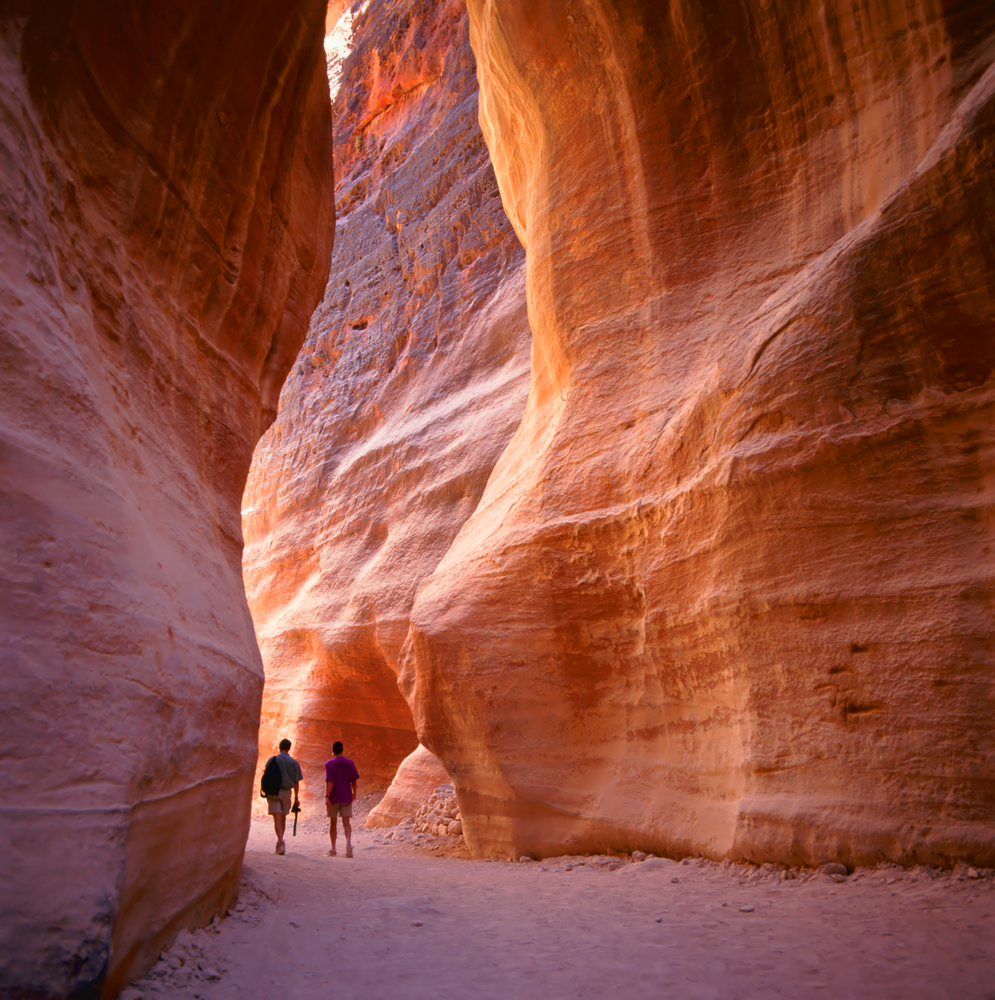
In time, after the Roman looting, the caravan trade petered out. Although the metropolis was occupied in the Middle Ages, it was hit by a series of earthquakes and was somewhen abandoned.
It was "rediscovered" by Johann Ludwig Burckhardt in 1812 and today it is a major tourist attraction. Contrary to the plot of the Indiana Jones movie, Petra is not located in a "Coulee of the Crescent Moon" and it is non the location of the Holy Grail.
Homes and h2o
Analysis of housing remains at ez-Zantur, inside Petra, suggests that people were building houses out of rock by ii,100 years ago, heralding a menstruum of urbanization.
This procedure would see people abandon their tents for more permanent rock dwellings, in some instances carving them into the cliffs. In time freestanding homes for the aristocracy would be created containing columns and multiple rooms.
Petra's main street, referred to today as the colonnaded street, would be built on the due south side of the Wadi Musa (a riverbed that sometimes has water). Walls would eventually be congenital on the north and south side of this wadi which, combined which Petra's cliffs, made the city very hard to invade.
A sophisticated plumbing system would also be built with a system of channels, pipes and cisterns to bring h2o to the people. Archaeologists recently found bear witness of this system during a geophysical survey of an area beside Petra'due south principal street.
All these developments, however, are today overshadowed by the design of the metropolis's tombs and temples.
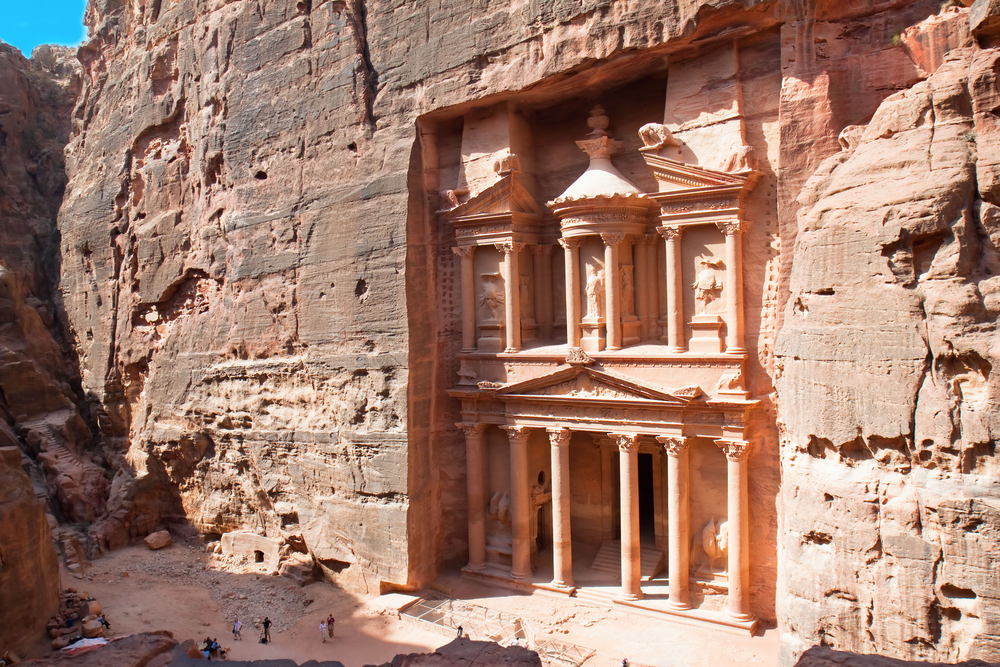
The 'Treasury'
Petra contains numerous tombs, most of them built at the edge of the city, beyond the chief street. Some were simple, containing multiple burials in an unadorned rock chamber, while others were more spectacular.
The all-time known tomb at Petra is called the "Khazneh," which is Standard arabic for the "Treasury." It is called this considering at 1 time local people believed it contained hidden treasure. Today, archaeologists regard it as a 2-story high tomb, albeit a masterful one. Its facade measures 82 feet (25 meters) broad and 128 feet (39 meters) loftier.
Mainly Greek in appearance, the columns are in a Corinthian style, the entrance flanked with reliefs depicting Brush and Pollux, a pair of mythical twin brothers. At meridian eye is a draped woman who may be a version of Isis, the Egyptian goddess. As well depicted at peak are 6 axe-wielding Amazons, mythical warrior women who were well-regarded in the aboriginal earth.
Also shown are griffins, eagles, two winged creatures known as "victories" and depictions of natural vegetation such equally poppies, grapes and pomegranates. Rosettes, a symbol of royalty, are also shown, indicating that this was the tomb of a king.
The interior of the tomb is relatively simple, containing a vestibule that branches off into three chambers, the largest one at center existence 40 feet (12.5 meters) by 36 feet (11 meters) and about 32 feet (10 meters) in height. Iii niches suggest that there were originally three sarcophagi.
There are no inscriptions, so it is not known who was buried in the tomb or when exactly information technology was built. Male monarch Aretas IV, who died in fifteen A.D. and had two wives, is a candidate, notes researcher Andrew Stewart, in a section of the book "Petra Rediscovered" (Thames & Hudson, 2003).
Aboriginal temples
Petra'due south ancient inhabitants maintained a rich spiritual life. Three temples located near the main street are believed to date to the urban center's zenith, near 2,000 years ago.
One of them is known as the Qasr al-Bint (a curt version of an Arabic name that translates "Castle of the Daughter of the Pharaoh"). Its walls are still preserved up to a top of 75 feet (23 meters). A person would walk up 19 stairs before coming to a landing, than another eight steps, past a series of four columns, to get in at the temple antechamber, before passing into a main hall that is almost square at 91 anxiety (28 meters) on each side. The holy of holies, a room with a platform, was at the end. A relief at the temple suggests that the structure may accept been dedicated to the god Dushara.
Another construction, known to archaeologists at the "Nifty Temple," contains a small theater in a design similar to a modern-day orchestra hall. Information technology was large enough to fit about 600 people with its outer layer of seats having a diameter of about 110 feet (33 meters). This theater may have been used for religious ceremonies. Amongst the temple decorations are depictions of elephant heads carved out of limestone.
A tertiary temple, located partly up a colina, is the Temple of the Winged Lions, then named because depictions of winged felines were found near its chantry. It contains an entryway and worship area with columns.
The temple itself is relatively minor, about 82 feet (25 meters) by 60 feet (18 meters). Withal, equally researcher Philip Hammond notes in the book "Petra Rediscovered," information technology has numerous support buildings, they "provided for housing of the temple personnel, pilgrims awaiting initiation into its rites, metal and oil fabrication areas, servicing facilities, and even for the production of religious artifacts for visiting tourists!"
— Owen Jarus, LiveScience Correspondent
Further reading:
- Jordan Tourism Lath — Petra
- Petra — UNESCO Globe Heritage Center
Source: https://www.livescience.com/23168-petra.html
0 Response to "what brought the city of petra to an end"
Post a Comment