what type of murders are the most difficult to solve
8.2 Types of Offense
Learning Objectives
- Depict the major aspects of homicide.
- Discuss evidence indicating that white-neckband crime is more serious than street crime.
- Explain the major issues raised by the concept of consensual law-breaking.
Many types of crime exist. Criminologists commonly group crimes into several major categories: (one) violent crime; (2) property criminal offence; (3) white-neckband crime; (4) organized offense; and (five) consensual or victimless crime. Inside each category, many more specific crimes exist. For example, fierce law-breaking includes homicide, aggravated and unproblematic assault, rape and sexual set on, and robbery, while property crime includes burglary, larceny, motor vehicle theft, and arson. Because a total discussion of the many types of offense would take several chapters or fifty-fifty an unabridged volume or more than, we highlight here the nigh important dimensions of the major categories of criminal offence and the issues they raise for public safety and crime control.
Violent Crime
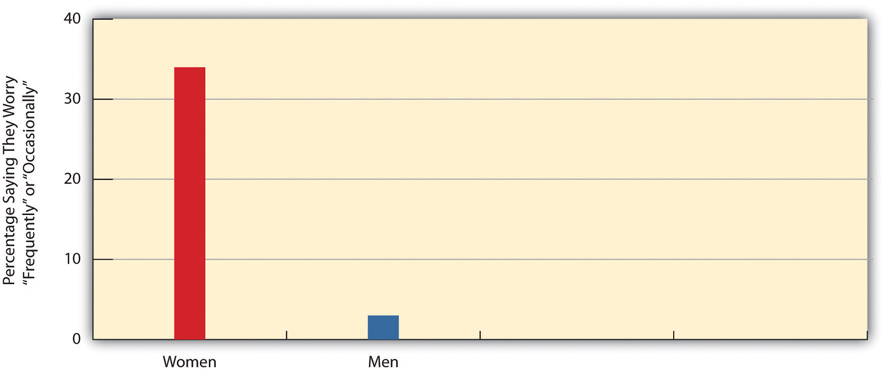
Fifty-fifty if, as our before discussion indicated, the news media exaggerate the problem of vehement law-breaking, it remains true that violent crime plagues many communities around the country and is the blazon of criminal offence that well-nigh concerns Americans. The news story that began this chapter reminds us that vehement criminal offence is all too real for also many people; information technology traps some people within their homes and makes others afraid to permit their children play exterior or even to walk to schoolhouse. Rape and sexual assault are a common concern for many women and leads them to be more than fearful of being victimized than men: In the 2011 Gallup poll mentioned earlier, 37 per centum of women said they worried almost existence sexually assaulted, compared to merely vi percent of men (see Figure viii.1 "Gender and Worry nearly Being Sexually Assaulted (Percentage Saying They Worry "Oftentimes" or "Occasionally")").
Figure 8.i Gender and Worry about Being Sexually Assaulted (Percentage Saying They Worry "Oft" or "Occasionally")
Research on violent offense tends to focus on homicide and on rape and sexual assault. Homicide, of course, is considered the near serious criminal offense considering it involves the taking of a man life. Likewise, homicide data are considered more accurate than those for other crimes because most homicides come up to the attention of the police and are more likely than other crimes to atomic number 82 to an arrest. For its part, the focus on rape and sexual assault reflects the contemporary women's motion's interest in these related crimes beginning in the 1970s and the corresponding interest of criminologists, both female person and male person, in the criminal victimization of women.
Certain aspects of homicide are worth noting. First, although some homicides are premeditated, well-nigh in fact are relatively spontaneous and the result of intense emotions similar anger, hatred, or jealousy (Play a trick on, Levin, & Quinet, 2012). Two people may begin arguing for any number of reasons, and things escalate. A fight may then ensue that results in a fatal injury, but one of the antagonists may also choice up a weapon and use it. About 25–50 per centum of all homicides are victim-precipitated, pregnant that the eventual victim is the one who starts the statement or the showtime one to escalate it once it has begun.
Second, and related to the first attribute, most homicide offenders and victims knew each other earlier the homicide occurred. Indeed, most three-fourths of all homicides involve nonstrangers, and just one-quaternary involve strangers. Intimate partners (spouses, ex-spouses, and current and former partners) and other relatives commit near 30 percent of all homicides (Messner, Deane, & Beaulieu, 2002). Thus although fear of a deadly attack by a stranger dominates the American consciousness, we in fact are much more likely on average to be killed by someone we know than past someone we do not know.

About two-thirds of homicides involve firearms, and half involve a handgun.
Third, about 2-thirds of homicides involve firearms. To be a bit more precise, just over one-half involve a handgun, and the remaining firearm-related homicides involve a shotgun, burglarize, or another undetermined firearm. Combining these start 3 aspects, then, the about typical homicide involves nonstrangers who take an argument that escalates and then results in the use of deadly force when one of the antagonists uses a handgun.
4th, nigh homicides (as almost violent crime in general) are intraracial, meaning that they occur within the same race; the offender and victim are of the same race. For single offender/single victim homicides where the race of both parties is known, about 90 percentage of African American victims are killed by African American offenders, and about 83 percent of white victims are killed by white offenders (Federal Bureau of Investigation, 2011). Although whites fear victimization by African Americans more than than by whites, whites in fact are much more likely to be killed by other whites than past African Americans. While African Americans do commit about half of all homicides, most of their victims are also African American.
Fifth, males commit nigh 90 percentage of all homicides and females commit simply 10 percentage. As we talk over in Section three.ane "Racial and Ethnic Inequality: A Historical Prelude", males are much more probable than women to commit most forms of crime, and this is specially true for homicide and other tearing crime.
Sixth, the homicide rate is much college in big cities than in modest towns. In 2010, the homicide rate (number of homicides per 100,000 population) in cities with a population at or over 250,000 was 10.0 percent, compared to only 2.5 percentage in towns with a population between ten,000 and 24,999 (see Figure viii.two "Population Size and Homicide Charge per unit, 2010"). Thus the risk for homicide is four times greater in large cities than in small towns. While virtually people in large cities certainly do non dice from homicide, where we alive still makes a deviation in our chances of being victimized past homicide and other crime.
Figure 8.2 Population Size and Homicide Rate, 2010
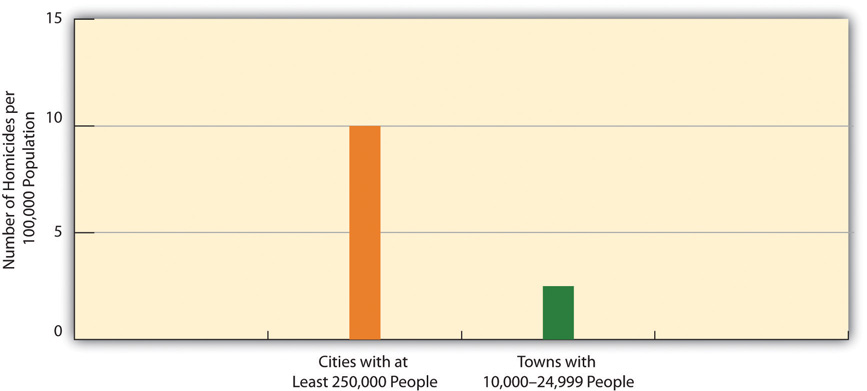
Source: Data from Federal Bureau of Investigation. (2011). Crime in the United States, 2010. Washington, DC: Author.
Finally, the homicide rate rose in the tardily 1980s and peaked during the early 1990s before declining sharply until the early on 2000s and and then leveling off and failing a scrap further since so. Although argue continues over why the homicide rate declined during the 1990s, many criminologists attribute the decline to a strong economy, an ebbing of gang wars over drug trafficking, and a pass up of people in the 15–25 age group that commits a disproportionate corporeality of crime (Blumstein & Wallman, 2006). Some observers believe rising imprisonment rates also fabricated a difference, and we return to this issue after in this affiliate.
Rape and sexual assault were included in Chapter 4 "Gender Inequality"'due south discussion of violence against women as a serious manifestation of gender inequality. As that chapter noted, it is estimated that one-third of women on the planet have been raped or sexually assaulted, beaten, or physically abused in some other way (Heise, Ellseberg, & Gottemoeller, 1999). While it is tempting to conclude that such violence is much more than common in poor nations than in a wealthy nation like the Us, we saw in Affiliate 4 "Gender Inequality" that violence against women is common in this nation as well. Like homicide, almost three-fourths of all rapes and sexual assaults involve individuals who know each other, not strangers.
Property Criminal offence
As noted before, the major belongings crimes are burglary, larceny, motor vehicle theft, and arson. These crimes are quite common in the Usa and other nations and, as Tabular array 8.1 "Number of Crimes: Uniform Law-breaking Reports (UCR) and National Offense Victimization Survey (NCVS), 2010" indicated, millions occur annually in this country. Many Americans accept installed burglar alarms and other security measures in their homes and like devices in their cars and SUVs. While property crime by definition does not involve physical damage, it nonetheless makes united states concerned, in part because information technology touches so many of united states of america. Although property criminal offense has in fact declined along with trigger-happy offense since the early 1990s, it notwithstanding is considered a major component of the crime problem, because it is so common and produces losses of billions of dollars annually.
Much property law-breaking tin exist understood in terms of the roles and social networks of property criminals. In this regard, many scholars distinguish between apprentice theft and professional theft. Most property offenders are apprentice offenders: They are young and unskilled in the means of criminal offence, and the amount they proceeds from any single theft is relatively modest. They also exercise not plan their crimes and instead commit them when they run into an opportunity for quick illegal proceeds. In dissimilarity, professional person belongings offenders tend to exist older and quite skilled in the ways of crime, and the amount they gain from any single theft is relatively big. Not surprisingly, they frequently plan their crimes well in accelerate. The so-chosen cat infiltrator, someone who scales tall buildings to steal jewels, expensive artwork, or large sums of money, is possibly the prototypical example of the professional belongings criminals. Many professional thieves learn how to do their crimes from other professional thieves, and in this sense they are mentored past the latter just every bit students are mentored by professors, and young workers past older workers.
White-Collar Crime
If you were asked to picture a criminal in your mind, what epitome would you exist likely to recall of first: a scruffy young male person with a scowl or sneer on his face, or a handsome, heart-aged man dressed in a three-piece business adjust? No doubt the sometime image would come to heed first, if only considering violent crime and property crime dominate newspaper headlines and television set newscasts and because many of u.s. have been victims of trigger-happy or property offense. However white-collar crime is arguably much more harmful than street law-breaking, both in terms of economic loss and of concrete injury, disease, and even death.
What exactly is white-collar criminal offence? The well-nigh famous definition comes from Edwin Sutherland (1949, p. 9), a sociologist who coined the term in the 1940s and defined information technology as "a crime committed by a person of respectability and high social condition in the grade of his occupation." Sutherland examined the behavior of the seventy largest US corporations and found that they had violated the police force hundreds of times amongst them. Several had engaged in crimes during either World War I or 2; they provided defective weapons and spoiled food to United states troops and fifty-fifty sold weapons to Germany and other nations the United States was fighting.
Although white-collar criminal offense as studied today includes auto shop repair fraud and employee theft past cashiers, bookkeepers, and other employees of relatively low status, almost research follows Sutherland's definition in focusing on crime committed by people of "respectability and high social status." Thus much of the study of white-collar crime today focuses on fraud by physicians, attorneys, and other professionals and on illegal beliefs past executives of corporations designed to protect or better corporate profits (corporate offense).
In the study of professional fraud, health-care fraud stands out for its extent and cost (Rosoff, Pontell, & Tillman, 2010). Health-care fraud is thought to amount to more than $100 billion per year, compared to less than $20 billion for all property crime combined. For example, some physicians bill Medicare and private insurance for services that patients do not really need and may never receive. Medical supply companies sometimes furnish substandard equipment. To compensate for the economical loss it incurs, health-care fraud drives upwardly medical expenses and insurance costs. In this sense, it steals from the public even though no one ever breaks into your firm or robs you at gunpoint.
Although health-care and other professional fraud are serious, corporate criminal offense dwarfs all other forms of white-collar law-breaking in the economical loss it incurs and in the death, injury, and illness information technology causes. Corporate financial crime involves such activities equally fraud, price fixing, and simulated advertisement. The Enron scandal in 2001 involved an energy corporation whose principal executives exaggerated profits. After their fraud and Enron'southward more dire financial state were finally revealed, the company's stock plummeted and it finally went broke. Its thousands of workers lost their jobs and pensions, and investors in its stock lost billions of dollars. Several other major corporations engaged in (or strongly suspected of doing and then) accounting fraud during the belatedly 1990s and early 2000s, but Enron was merely the most notorious example of widespread scandal that marked this menses.
While corporate fiscal crime and corruption have cost the nation untold billions of dollars in this and earlier decades, corporate violence—actions by corporations that impale or maim people or leave them sick—is fifty-fifty more scandalous. The victims of corporate violence include corporate employees, consumers of corporate goods, and the public as a whole. Annual deaths from corporate violence exceed the number of deaths from homicide, and affliction and injury from corporate violence affect an untold number of people every year.
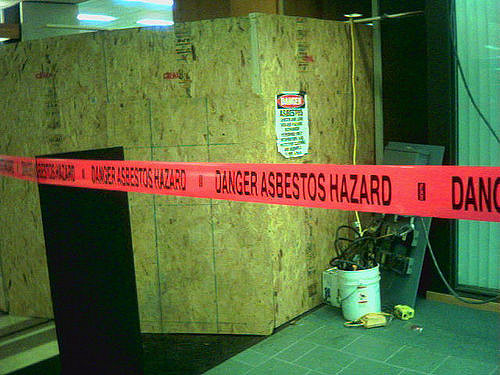
The asbestos manufacture learned in the 1930s that asbestos was a major health take a chance, only information technology kept this discovery a hugger-mugger for more than three decades.
Employees of corporations suffer from unsafe workplaces in which workers are exposed to hazardous conditions and chemicals considering their companies fail to take adequate measures to reduce or eliminate this exposure. Such exposure may result in illness, and exposure over many years can result in death. According to a recent estimate, more than 50,000 people dice each year from workplace exposure (American Federation of Labor and Congress of Industrial Organizations [AFL-CIO], 2010), a figure about three times greater than the number of annual homicides. About 1,500 coal miners die each year from black lung disease, which results from the breathing of coal dust; many and perhaps most of these deaths would be preventable if coal mining companies took adequate prophylactic measures (Thousand. Harris, 1998). In another case, the asbestos industry learned during the 1930s that exposure to asbestos could crusade fatal lung disease and cancer. Despite this knowledge, asbestos companies hid evidence of this hazard for more than than 3 decades: They immune their workers to continue to work with asbestos and marketed asbestos as a fire retardant that was widely installed in schools and other buildings. More than 200,000 asbestos workers and members of the public either have already died or are expected to die from asbestos exposure; almost or all of these deaths could take been prevented if the asbestos industry had acted responsibly when it first discovered information technology was manufacturing a dangerous product (Lilienfeld, 1991).
Dangerous products also kill or maim consumers. One of the about notorious examples of deaths from an unsafe product involved the Ford Pinto, a car offset sold in the early 1970s that was vulnerable to fire and explosion when hit from behind in a small-scale rear-end collision (Cullen, Maakestad, & Cavender, 2006). Ford knew before the Pinto went on the market that its gas tank was unusually vulnerable in a rear-end collision and determined it would accept about $11 per car to set the problem. Information technology then did a price-benefit analysis to determine whether it would cost more than to prepare the problem or instead to settle lawsuits later Pinto drivers and passengers died or were burned and injured in rear-end collisions. This analysis indicated that Ford would save about $87 one thousand thousand if it did not fix the problem and instead paid out compensation after Pinto drivers and passengers died or got burned. Because Ford made this conclusion, about five hundred people somewhen died in Pinto rear-end collisions and many others were burned.
The toll of white-collar law-breaking, both financial and tearing, is difficult to approximate, but past all accounts information technology exceeds the economical loss and death and injury from all street criminal offence combined. White-collar crime is thought to involve an annual economical loss of more $700 billion annually from corporate fraud, professional fraud, employee theft, and tax evasion and an almanac toll of at to the lowest degree 100,000 deaths from workplace-related illness or injury, unsafe products, and preventable environmental pollution. These figures compare to an economic loss of less than $xx billion from property crime and a decease cost of nearly 17,000 from homicide (Barkan, 2012). By whatever measure, the toll of white-collar crime dwarfs the cost of street crime, even though the latter worries us much more than than white-neckband criminal offense. Despite the harm that white-neckband crime causes, the typical corporate criminal receives much more lenient punishment, if whatsoever, than the typical street criminal (Rosoff et al., 2010).
Organized Law-breaking
Organized criminal offence refers to criminal activity by groups or organizations whose major purpose for existing is to commit such law-breaking. When we hear the term "organized crime," nosotros almost automatically think of the so-called Mafia, vividly portrayed in the Godfather movies and other films, that comprises several highly organized and hierarchical Italian American "families." Although Italian Americans accept certainly been involved in organized law-breaking in the Usa, so have Irish Americans, Jews, African Americans, and other ethnicities over the years. The accent on Italian domination of organized crime overlooks these other involvements and diverts attending from the actual roots of organized law-breaking.
What are these roots? Simply put, organized crime exists and even thrives considering it provides goods and/or services that the public demands. Organized law-breaking flourished during the 1920s because it was all too ready and willing to provide an illegal production, alcohol, that the pubic continued to demand even after Prohibition began. Today, organized law-breaking earns its considerable money from products and services such equally illegal drugs, prostitution, pornography, loan sharking, and gambling. Information technology as well began long ago to branch out into legal activities such as trash hauling and the vending manufacture.
Government efforts against organized crime since the 1920s take focused on arrest, prosecution, and other police-enforcement strategies. Organized crime has certainly continued despite these efforts. This fact leads some scholars to emphasize the need to reduce public need for the goods and services that organized offense provides. However, other scholars say that reducing this demand is probably a futile or generally futile task, and they instead urge consideration of legalizing at least some of the illegal products and services (eastward.g., drugs and prostitution) that organized crime provides. Doing and so, they contend, would weaken the influence of organized offense.
Consensual Crime
Consensual crime (also called victimless crime) refers to behaviors in which people engage voluntarily and willingly even though these behaviors violate the law. Illegal drug apply, discussed in Chapter vii "Alcohol and Other Drugs", is a major form of consensual law-breaking; other forms include prostitution, gambling, and pornography. People who use illegal drugs, who rent themselves out as prostitutes or utilize the services of a prostitute, who take a chance illegally, and who utilise pornography are all doing so because they want to. These behaviors are non entirely victimless, as illegal drug users, for example, may harm themselves and others, and that is why the term consensual crime is often preferred over victimless criminal offence. As just discussed, organized crime provides some of the illegal products and services that compose consensual law-breaking, only these products and services certainly come from sources other than organized crime.
This result aside, the existence of consensual criminal offense raises ii related questions that nosotros start encountered in Chapter 7 "Booze and Other Drugs". Starting time, to what degree should the government ban behaviors that people willingly commit and that generally practice not have unwilling victims? Second, practice regime attempts to ban such behaviors practise more proficient than harm or more harm than good? Chapter 7 "Booze and Other Drugs"'due south discussion of these questions focused on illegal drugs, and in detail on the problems acquired by laws against certain drugs, simply similar problems arise from laws against other types of consensual crime. For example, laws confronting prostitution enable pimps to control prostitutes and assistance ensure the transmission of sexual diseases because condoms are not regularly used.
Critics of consensual crime laws say we are now in a new prohibition and that our laws against illegal drugs, prostitution, and certain forms of gambling are causing the aforementioned problems at present that the ban on alcohol did during the 1920s and, more more often than not, crusade more than harm than good. Proponents of these laws respond that the laws are notwithstanding necessary as an expression of society'south moral values and as a means, however imperfect, of reducing involvement in harmful behaviors.
Key Takeaways
- Well-nigh homicides are committed for relatively emotional, spontaneous reasons and between people who knew each other beforehand.
- White-collar crime involves more than death, injury, and economical loss than street law-breaking, but the punishment of white-collar crime is relatively weak.
- Consensual crime raises 2 related bug: (a) To what extent should the government prohibit people from engaging in behavior in which at that place are no unwilling victims, and (b) do laws against consensual law-breaking do more good than harm or more harm than good?
For Your Review
- If homicide is a relatively emotional, spontaneous offense, what does that imply for efforts to use harsh legal penalisation, including the death penalty, to deter people from committing homicide?
- Do y'all retrieve consensual crimes should be made legal? Why or why not?
References
American Federation of Labor and Congress of Industrial Organizations (AFL-CIO). (2010). Expiry on the task: The price of neglect. Washington, DC: Author.
Barkan, S. E. (2012). Criminology: A sociological understanding (5th ed.). Upper Saddle River, NJ: Prentice Hall.
Blumstein, A., & Wallman, J. (Eds.). (2006). The crime drop in America (2nd ed.). Cambridge: Cambridge University Press.
Federal Bureau of Investigation. (2011). Crime in the United states of america, 2010. Washington, DC: Federal Author.
Fox, J. A., Levin, J., & Quinet, K. (2012). The will to kill: Making sense of senseless murder. Upper Saddle River, NJ: Prentice Hall.
Harris, G. (1998, Apr 19). Despite laws, hundreds are killed by black lung. The Courier-Periodical (Louisville, KY), p. A1.
Heise, L., Ellseberg, Thousand., & Gottemoeller, M. (1999). Catastrophe violence confronting women. Population Reports, 27(4), one–44.
Cullen, F. T., Maakestad, W. J., & Cavender, K. (2006). Corporate crime under attack: The fight to criminalize business violence. Cincinnati, OH: Anderson.
Lilienfeld, D. Due east. (1991). The silence: The asbestos industry and early occupational cancer research—a instance written report. American Periodical of Public Wellness, 81, 791–800.
Messner, S. F., Deane, Yard., & Beaulieu, M. (2002). A log-multiplicative association model for allocating homicides with unknown victim-offender relationships. Criminology, xl, 457–479.
Rosoff, Southward. M., Pontell, H. North., & Tillman, R. (2010). Profit without honor: White collar criminal offense and the looting of America (5th ed.). Upper Saddle River, NJ: Prentice Hall.
Sutherland, E. H. (1949). White collar crime. New York, NY: Holt, Rinehart, and Winston.
Source: https://open.lib.umn.edu/socialproblems/chapter/8-2-types-of-crime/
0 Response to "what type of murders are the most difficult to solve"
Post a Comment